

The report shows thirty new enquiries. The salesperson says hardly any were useful. Both may be right. One counts submitted forms; the other counts opportunities the business can and wants to serve.
Evaluating a website only by the first number can reward campaigns that generate administration rather than sales. Connect the arrival of a contact with what happens next. This guide covers enquiry quality and progression; the overall financial calculation belongs in the marketing ROI guide.
Record receipt, source, qualification and sales status for each enquiry. Agree in advance what constitutes a suitable opportunity. Compare cost per qualified enquiry, proposals and won business alongside cost per contact. Do not treat recent, unresolved contacts as definitive losses.
Define a good enquiry for your business
"Looks interesting" is not a rule that supports month-to-month comparison. Qualification should reflect the offer and capacity. Does the customer need a service you deliver? Are the scope and deadline feasible? Is there a sensible next step?
Write a few criteria the sales team understands consistently. A complex score is not essential. A small business might use suitable, unsuitable and not yet clear, with a short reason. The last category prevents missing information from automatically becoming a poor-quality label.
Do not automatically disqualify every lost proposal. A customer may have been a good fit but selected a competitor. That is a different problem from spam or requests for a service you do not provide.
Separate receipt, qualification and outcome
A practical record can track enquiry receipt, qualification, proposal and closure. Add dates to status changes. For a lost opportunity, record the reason if you actually know it; do not invent the customer's explanation.
Consider a fictional example. Two campaigns each cost CZK 10,000. The first brings forty contacts, four of them suitable. The second brings ten contacts, five suitable. Cost per contact is CZK 250 versus CZK 1,000, but cost per suitable enquiry is CZK 2,500 versus CZK 2,000.
That does not establish which campaign earned more. Won business, value, costs and time are still missing. It only illustrates why form acquisition cost alone can mislead. These are example figures, not client campaign results.
A simple spreadsheet can be enough initially
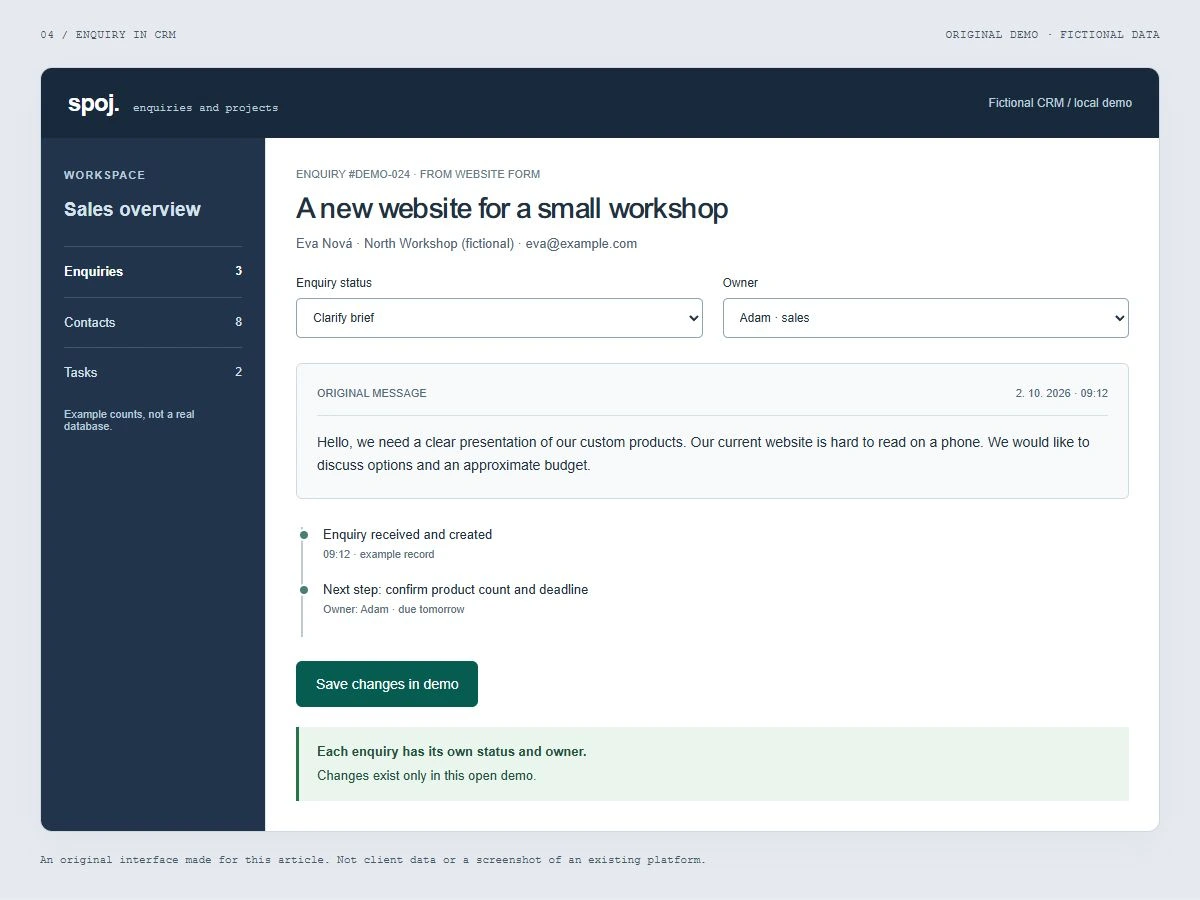
Record an internal identifier, receipt date, source, requested service, owner, qualification and sales outcome. Add the last contact date and next action. Keep contact details in an appropriate business system with restricted access.
A CRM helps when the spreadsheet becomes inadequate. The purpose is consistent history, not another tool. If you already use a CRM, standardise status names and responsibility for updates. Otherwise, an attractive dashboard will still contain incomplete data.
The technical handover is covered in connecting a website to a CRM. Reliable receipt comes first; only then can you meaningfully assess what happened to the request.
Worked example: An enquiry is not always an opportunity
ORIGINAL EXAMPLE · FICTIONAL DATA
| Record | Need and owner | Qualification | Next step |
|---|---|---|---|
| D-01 / website / 3 Oct | New catalogue / Eva | Service fit | Discuss brief |
| D-02 / form / 3 Oct | Advertising pitch / Adam | Not a customer | Close |
| D-03 / referral / 3 Oct | Redesign / Eva | Scope unknown | Ask follow-up |
Fictional records without personal contact details.
Analytics must distinguish a click from receipt
Clicking submit can end in a validation error. Tie an accepted-enquiry event to verified receipt rather than the button press alone. Handle duplicate retries and separate internal tests.
Google Analytics documents recommended lead events, including generate_lead, qualify_lead and close_convert_lead. Map them to genuine business states. Renaming a button click as a won sale does not improve measurement.
Do not send names, email addresses, telephone numbers or complete enquiry messages in ordinary analytics events, URLs or campaign parameters. Google prohibits personally identifiable information in Analytics. Design collection and linking around the tools and privacy requirements involved; sales records and web analytics do not need identical data.
Compare enquiries of similar age
A complex service may take weeks to sell. Comparing contacts from the last three days with contacts received two months ago naturally gives the newer campaign fewer completed deals.
Group enquiries by receipt date and keep unresolved cases visible. With small volumes, inspect individual records as well as totals. One large deal can substantially change percentages without establishing a lasting trend.
Attribution is not always known. People call, return later or decline analytics tracking. An "unknown" category is more honest than invented attribution. Asking a customer how they found you can help, but it records their recollection rather than the entire journey precisely.
Turn the report into a specific change
Many irrelevant requests? Review targeting and offer clarity. Suitable contacts receive no reply? Fix ownership and capacity. Proposals fail because scope is unclear? Improve the brief and proposal presentation.
At a regular review, examine the counts, several actual records and one change to evaluate next. If the website first needs to reflect the work you want to win, start with my business website development service.