
The best generator may mean the most attractive first attempt, the closest match to a brief or the lowest cost per usable picture. One system does not necessarily win all three. This guide separates independent preferences, price and practical selection.
Data snapshot: 2 October 2026. This is a limited selection from a public benchmark, not my own test of every listed model. Illustrative photographs are not attributed outputs from the competing models. Variant names matter: high and max cannot simply be dropped.
Which models lead text-to-image?
GPT Image 2.5 Sunburst (max) led the overall AA-Image-T2I v2.0 board when checked. Second-place Flare had an overlapping uncertainty interval: six Elo points do not establish a clear advantage for every prompt.
| Rank | Model | Elo and 95% interval | Samples | Indicative API price / image |
|---|---|---|---|---|
1 |
GPT Image 2.5 Sunburst (max) |
1197 ± 9 |
14,212 |
$0.2107 |
2 |
GPT Image 2.5 Flare (max) |
1191 ± 9 |
13,591 |
$0.2107 |
3 |
GPT Image 2 (high) |
1172 ± 9 |
15,383 |
$0.2110 |
6 |
Nano Banana 2 |
1125 ± 8 |
18,759 |
$0.0670 |
7 |
Muse Image |
1115 ± 9 |
8,695 |
$0.0100 |
All values: Artificial Analysis text-to-image. Prices divide the listed per-thousand rates, rather than quoting my services or guaranteeing subscription costs. This is a selection, not the complete ranking. Samples retains the source's term; it does not mean unique customers.
What Elo measures and what it leaves out
Elo describes relative preference between outputs, not percentage accuracy. Do not turn an Elo difference into a percentage quality improvement. Read the methodology, task mix, model eligibility and uncertainty. The image benchmark methodology distinguishes generation, editing and reference-based tasks.
An overall score cannot tell you whether a model renders Czech lettering correctly, preserves a particular package or supports your mobile crop. Write those requirements before comparing outputs. An unwanted background colour may be a briefing problem; a handle disappearing after every edit is a different failure.
Choose around the work
For a free-form illustration, judge concept, composition and format fit. For a product, check shape, material, component count and reference accuracy. For an advertisement, add negative space, hierarchy and editability. For text inside the image, inspect every letter, accent and small label.
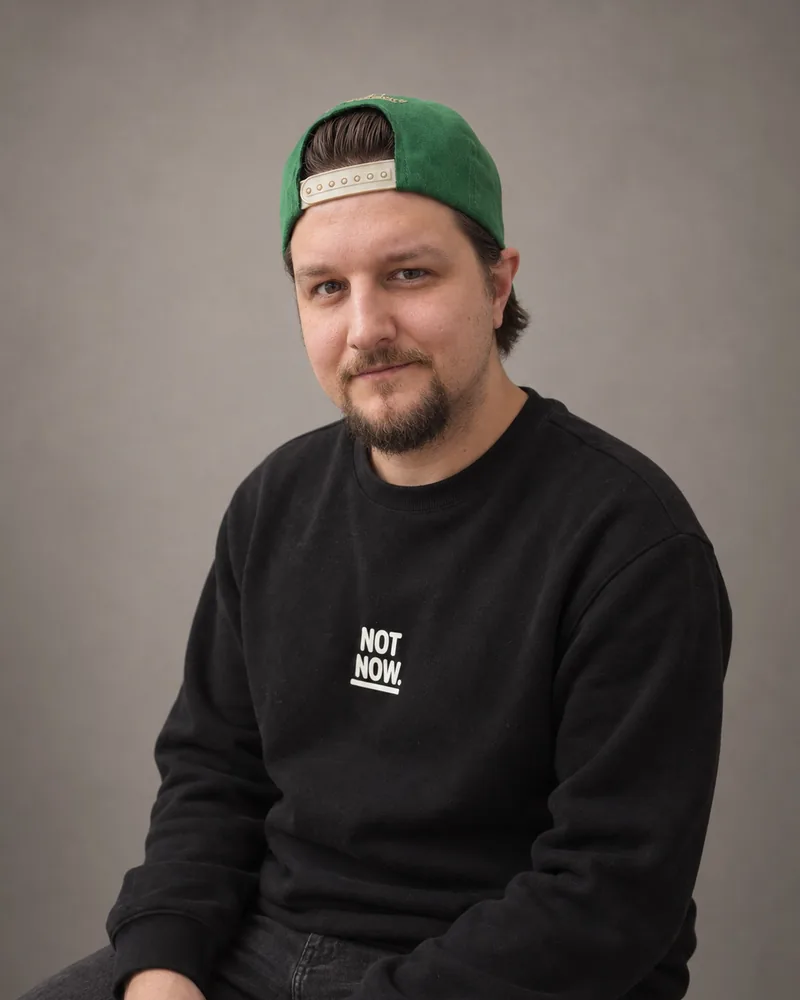
For a portrait, also inspect eyes, the hairline, skin texture and clothing connections. The example below contains no hands, so it cannot establish hand anatomy quality. For an interior, inspect perspective and object count instead.
Shortlist with statistics, then decide using representative tasks of your own. A practical small test uses an identical brief and format, three attempts per model and rejection criteria set in advance. Hide model names when reviewing to reduce brand bias. Three attempts do not make a scientific benchmark; they offer an affordable check before larger production.

Generation and editing are different decisions
Creating an attractive scene from scratch differs from replacing its background while preserving the product. Define what can change and what must remain: shape, colour, lettering, camera angle and object count. Evaluate unwanted changes outside the requested area too.
OpenAI's image documentation distinguishes generation and editing with reference inputs. Check the exact model and interface. An API capability does not guarantee identical controls in a consumer application.
Do not present a freely invented image as an accurate photograph of a real product for sale. Compare reference-based work with the original. A changed pocket size or fabric colour can mislead a customer even if the image looks expensive.
Do images really cost pennies?
A cheap individual API output can cost a fraction of a Czech crown. That does not extend the lowest rate to every model, resolution and quality setting. The leading max variant in this snapshot costs materially more than inexpensive options. Check the provider's rate card, image inputs and selected quality as well.
Use this calculation: usable-image cost = all attempts + edits + any upscaling + review time. An illustrative example, not provider measurements: twelve attempts at $0.01 cost $0.12. Three at $0.05 cost $0.15. If the second approach saves twenty minutes of retouching, generation price alone no longer decides the choice.
Any currency conversion needs an exchange rate. A planning rate is fine if labelled as an assumption. A capped subscription also has no universal cost per picture: it depends on how much included capacity you actually use.
Clean design starts before generation
A higher score will not fix "make something premium". Decide the main object, material, lighting direction, empty areas and text placement. Combining cinematic, luxury and futuristic indiscriminately can create conflicting directions.

See AI images without AI slop for prompts and three generated scenes. To choose the broader working application, start with the assistant comparison. Separating the model, application and subscription prevents mistaken expectations. If your team should use image generators under shared rules (briefs, output checks, licences, brand style), I teach exactly that in AI training for companies, using your own products and campaigns.
Frequently asked questions
Is the first model in the table best for me?
It leads a specific overall benchmark at the recorded date. Your style, edits and language requirements still need testing.
Why is there no single value-for-money winner?
I do not know your attempt count, correction workload or interface pricing. A small test with rejection criteria is more honest than a universal badge.