In brief
Short educational games with original artwork and a clear learning goal: a textbook companion, a whiteboard game or a playable prototype for edtech. It is for schools, publishers and edtech companies that want a game, not another template quiz; the game runs in a browser without installation. A mini game starts at €320, and the first step is always a playable prototype.
| Plan | Price | Scope |
|---|---|---|
| Mini game | from €320 | 1 mechanic, 1 set of tasks |
| Exercise set for a chapter | from €800 | 3-5 short games on one topic |
| Game with original artwork | from €1,800 | characters, a story, several levels |
| School licence | from €60/year | rent a finished game from the set |
How we work together
- Timeline:
- depends on scope, I confirm it after the consultation
- Process:
- Brief → Playable prototype → Development and handover
- Who does it:
- Marek Frňka, personally, from first call to launch. About me
- Proven on:
- i-EDUKO (publisher platform)
Eight examples across ages and subjects
From primary school to university. You see each game play for 10 seconds, and each one lists what it teaches, the age it is designed for and what it is played on.
English
A Wardrobe for Bubu
designed for ages 7–10 · mobile
English
Free the Animals
designed for ages 7–10 · mobile
Natural sciences
Electric circuit
school year 8 · mobile
Trades and practice / Natural sciences
Titration
lab technician · mobile
English
Class Rocket
designed for ages 7–10 · whiteboard, PC
Two teams build rockets with correct answers, countdown and launch. Connecting tablets is not part of the demo.
Trades and practice
Wiring a socket
electrician · PC
Connect the L, N and PE wires to the right terminals and tighten the screws. Swapped wires show ERROR on the check; once fixed it shows OK and the socket gets its cover.
Trades and practice
Wheel bolts
car mechanic · PC
Hand-start the five wheel bolts, then tighten them in a star pattern: half torque first, then full. Going round the rim tilts the wheel; the star pattern lets it run true.
Computing and technology
Gear ratio
mechanical engineering · PC
The player builds a gear train so that 1,200 rpm drops to 300 rpm in the same direction of rotation. Every mesh reverses the direction: one mesh gives 4 : 1 but the opposite direction, only two meshes (2 × 2) give the right result.
Related work in practice
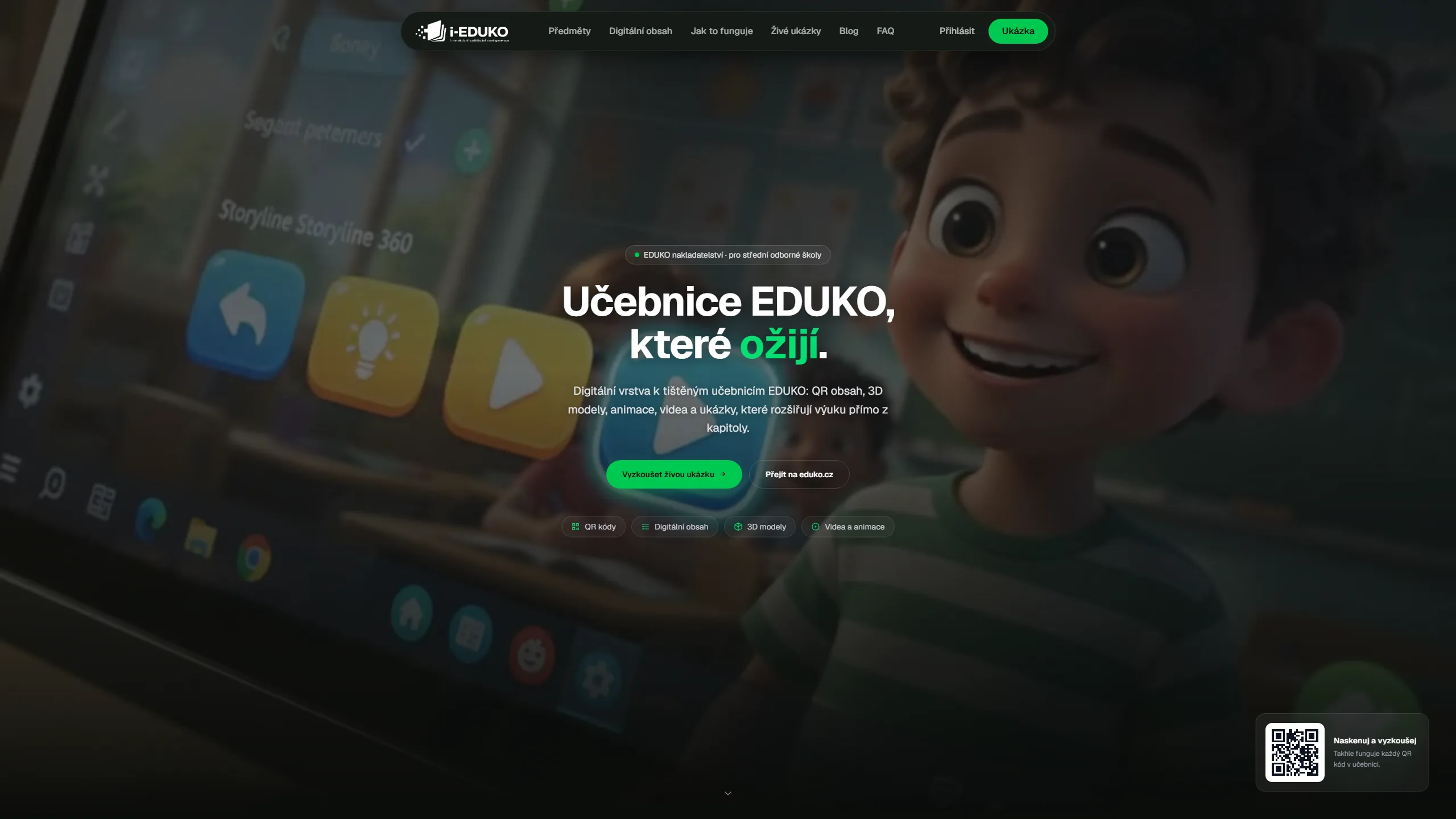
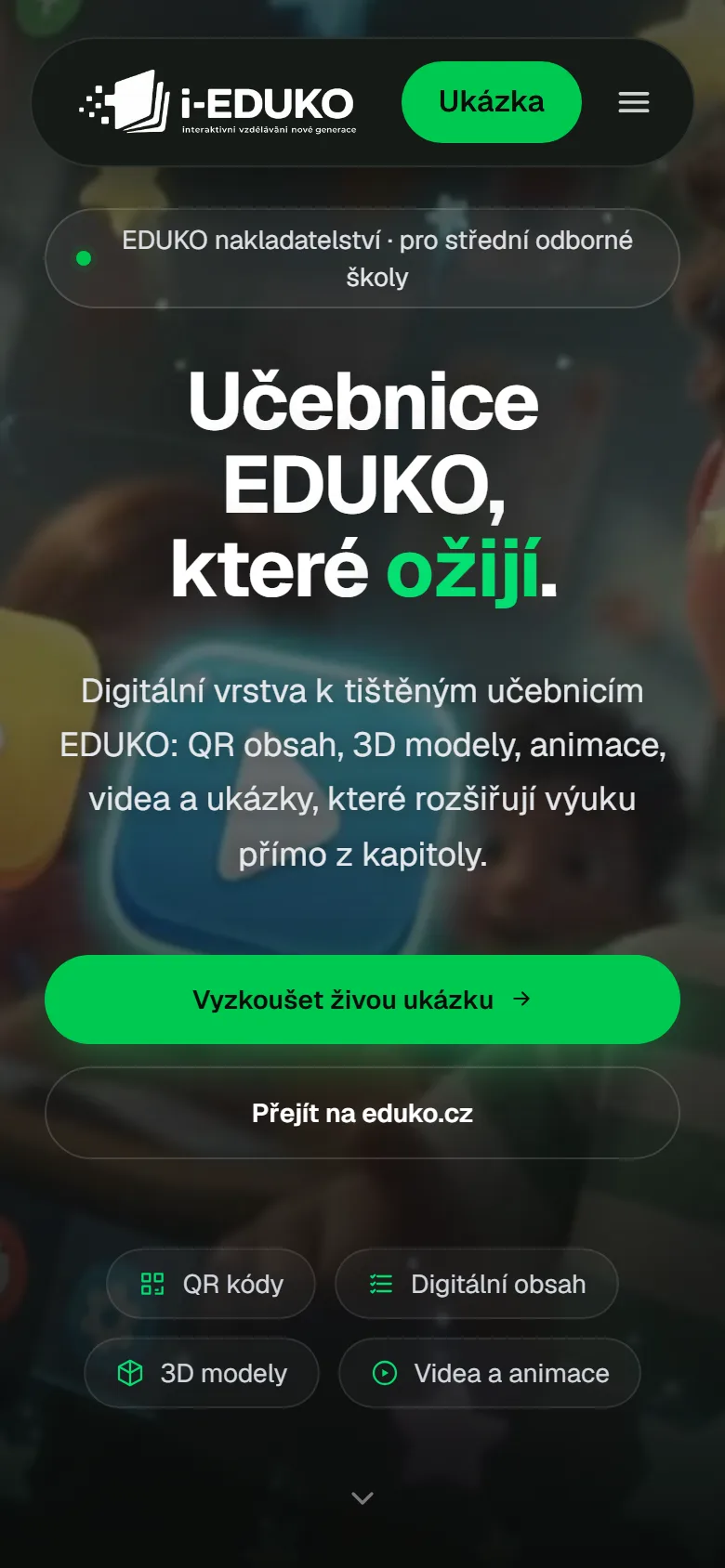
A concrete project with desktop and mobile previews. No illustrative mockup, just a real website, e-shop or digital product.
EDUKO
i-EDUKO and e-EDUKO for a publisher, Digital platform for the EDUKO publishing house: it manages its digital content and delivers it to students via QR codes in printed textbooks, interactive exercises, 3D models and learning videos.
What you actually get
No fog: what you get, who it fits and where a larger scope begins.
Clear deliverables
- an outline of what the pupil should learn, for what age and where the game will be played
- a playable prototype of one gameplay scenario before the full build starts
- its own visual style for the game, not a template
- a web version ready to embed in a textbook or your product
- a link or QR code that opens the game
Best fit
- you are a publisher and want a digital companion to a textbook
- you are a school or an edtech company and want a game for your subject or a playable prototype
- you want to try one playable sample first and decide afterwards
Not a fit
- you need a few exercises for one topic, where interactive exercises are cheaper
- you are looking for a large commercial game for Steam or consoles
- you expect a finished game in a week without a brief or approvals
Scope boundaries
A mini game with one mechanic costs from €320, a set of 3–5 exercises for a chapter from €800 and a game with original artwork, characters and several levels from €1,800. That is a purchase, meaning an exclusive licence in the agreed scope, typically for publishers. A school can rent a finished game from €60 per year; changes and work beyond the package cost €60/h. I give the exact price based on scope. I am not a VAT payer.
Prices for schools and publishers
Purchase means an exclusive licence in the agreed scope, typically for publishers. Schools can rent a finished game under a licence to use. Prices start at the amount shown; I will give you an exact price based on scope. Changes to a finished game and work beyond the package cost €60/h. I am not a VAT payer.
A textbook in motion
I design and build short educational games with original graphics and a clear learning objective. For publishers, a digital companion to a textbook; for edtech companies, a playable prototype; for schools, a game for their own subject. For companies I make gamified onboarding and e-learning.
Every game lists what it teaches, the age it is designed for and the device it is played on. You can watch the games in the game portfolio play for ten seconds each; the clips are recordings of playable web prototypes, and I show the playable versions live during a consultation. Before you commission a game, it is worth reading how to commission an educational game and what research says about gamification.
I do not start with a long specification. First comes a playable prototype of one gameplay scenario that you try in the browser, and only then you decide on the full game. A game does not pay off for one topic and one class; there, interactive exercises from €140 are cheaper. More of my work is in the portfolio.
Who I make games for
Mainly those who publish educational content. Also schools and businesses that want to turn learning material into a game.
Textbook publishers
A digital companion to a lesson: a short game about vocabulary, grammar or a specialist topic. Pupils open it from a link or QR code in the textbook.
Edtech companies
A playable prototype of a new feature, a game layer for your content, or game art and animation for your existing product.
Schools and projects
Primary and secondary schools and universities, usually as part of a project or grant: a game for your subject, on a board for the whole class or on a mobile device.
Businesses
Gamified e-learning and onboarding: instead of another test, a short game where a new colleague can put the rules into practice.
Licences, technology and AI
Two licence options, each priced differently. Copyright stays with me in both cases.
Purchase (exclusive licence)
An exclusive licence in the agreed scope, typically for publishers. The libraries, fonts and sounds used have free licences (MIT, OFL), and for a commissioned game you receive a list documenting the origin of every asset.
School licence
A licence to use a finished game, typically for schools: a school rents a finished game from the set, and the copyright stays with me.
Technology and clips
The games run in a browser without installation (Phaser, three.js, Matter.js, all MIT-licensed). The mobile examples are designed for portrait orientation and run at a smaller size on a computer. The clips are scripted recordings, not footage of a child playing.
My contribution and AI's
The brief, selection and art direction are mine. For the demos outside Eduko, AI (Claude and Codex) created the code, procedural graphics, animations and sounds from my brief and feedback. The ages shown are my suggestions based on difficulty, not the results of classroom testing.
What the game does
What you concretely get out of the collaboration.
- 01
In a browser, no install
The game runs in a browser on a mobile, a computer or an interactive whiteboard, depending on the game. It opens from a link or a QR code in the textbook. We agree any account requirements or platform integration in the brief.
- 02
A clear learning objective
We settle the brief before anything is built: what the pupil should learn, the intended age and the device. Each example lists its learning objective, age and platform.
- 03
Its own visual style
Every game gets its own visual style, such as a paper puppet, linocut, screen print or 3D. No template quizzes.
- 04
Verified content
I use facts only from your materials or a verified, dated source. Before handover, your editorial team or teacher reviews and approves the content.
How it works
No unnecessary bureaucracy. Every step has a clear output and deadline, you always see exactly where we are.
- Typically
- depends on scope, I confirm it after the consultation
- Steps
- 3
Brief
before the startTogether, we define what the pupil should learn, the intended age, where the game will be played (mobile, computer, board) and where the content comes from. I use facts only from your materials or a verified, dated source.
Playable prototype
first sampleOne gameplay scenario with its own visual style, like the examples on this page. Try it in your browser, show it to colleagues or children, and tell me what to adjust.
Development and handover
handoverI develop the game to its full scope: all tasks, sounds and text for review. I deliver a web version ready to accompany your textbook or be embedded in your product.
Common questions
The ones asked most. Missing something? Write to me, I reply within a few hours.
A mini game with one mechanic starts at €320, a set of 3–5 exercises for a chapter at €800, and a game with original artwork, characters and several levels at €1,800. A school licence for a finished game starts at €60 per year; changes cost €60/h. I am not a VAT payer.
Have a textbook, a lesson or a product that could be played?
Tell me what you teach and to whom. I will get back to you with a proposal of what a first playable sample could look like.