
Most enquiries for an educational game start with "we would like some kind of game for our textbook". That is a good start for a conversation, but not enough for a quote. Until you know what the student should learn, what they will play on and who owns the game after delivery, three suppliers will give you three prices you cannot compare. This article is a guide to briefing a custom educational game so it can be priced, built and used. A one-page brief template is at the end.
How do you brief a custom educational game? Write one testable learning goal, the age and grade, the devices (phone, computer, interactive whiteboard), who supplies and checks the content, how the game should look and where it will be used (a link, a QR code in a textbook, an LMS). Agree whether you are buying the game (under Czech law this means an exclusive licence) or renting it under a licence. With me, a mini game starts at €320, an exercise set for a chapter at €800, a game with original artwork at €1,800 and a school licence for a finished game at €60 per year.
1. Learning goal: one sentence you can test
The most important line of the brief. A game without a clear goal ends up as a quiz with animations. A good goal describes what the student does, not which topic is covered:
- Weak: "Practise English grammar."
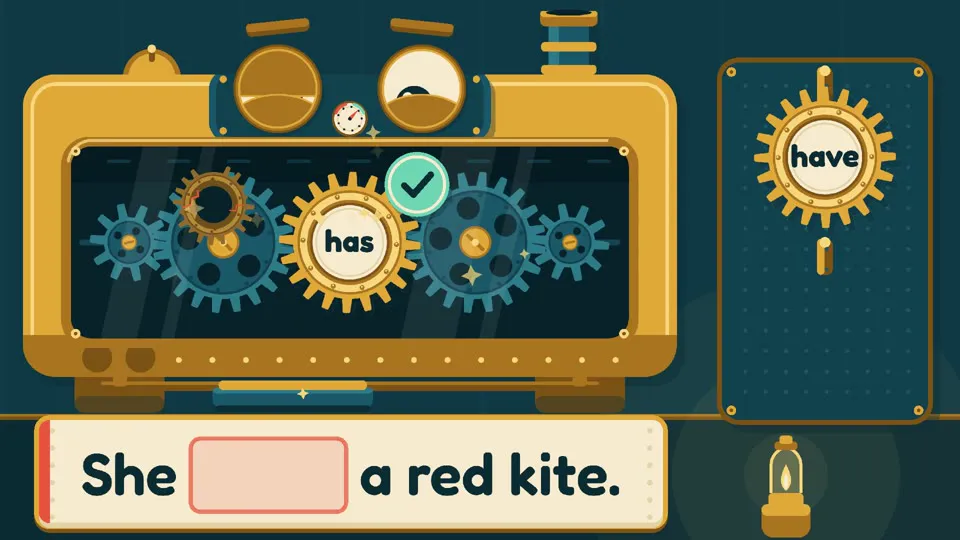
- Good: "Fill in has/have or is/are to match the subject of the sentence." That is exactly what my Sentence repair workshop is built on: the right cog repairs the sentence, the wrong one jams the machine.
One goal per short game. If you have five, that is a set of five games, not one big one.
2. Who plays, where and for how long
- Age and grade. Drives the length of texts, the size of controls and the difficulty.
- Device. A phone in portrait, a computer, or an interactive whiteboard for the whole class. A whiteboard game (such as my Class rocket for two teams) is designed completely differently from a phone game.
- Alone or with a teacher. Homework practice, pair work, a team competition in class.
- Length and repetition. Research favours short games that students come back to: in the meta-analysis by Clark et al. (2016), a single-session game had a practically zero effect, while repeated play did much better. Details are in Gamification in education: what the research says.
- Login. Should the game run without an account, or store results? Without logins and without students' personal data, deployment in a school is simplest.
3. Content and facts: who supplies and who checks them
With publishers the editorial team usually supplies the tasks; with schools, the teacher. Put in the brief:
- who prepares the list of tasks, words or situations,
- who reviews and approves the content in the game,
- for specialist subjects (chemistry, accounting, law), the source and the date the facts are valid for.
I take facts only from your materials or from a verified source with a date. A demo whose subject content has not been verified yet is not published as finished teaching content, only as a demo of artwork and controls.
4. Look: follow the textbook, not a template
When a game belongs to a textbook, it should look like it: the same characters, colours, typeface. Send sample pages or the series style guide. If you do not have a style, ask for two or three directions on one game situation before you decide. Every one of my demos has its own art style (paper puppet, screen print, brass and vector) precisely so it does not look like yet another quiz template. For example, Class Rocket is a screen print for two teams at one whiteboard, Robot for teaching loops is an isometric miniature and Titration is built on laboratory glass in 3D.
5. Where the game will be used
- A link or QR code in a textbook. The game runs in the browser; the student opens it on a phone without installing anything.
- Embedded in your website or platform (edtech, a publisher's portal).
- An LMS (Moodle and similar). If you need results in the LMS, say so in the brief straight away; export and testing in an LMS are separate work.
6. Accessibility: two rules that get forgotten
WCAG 2.2 (W3C Recommendation, current edition of 12 December 2024) has two success criteria that games break most often:
- 2.2.1 Timing Adjustable (level A). If a game measures time, it must be possible to extend or switch it off. Points for speed penalise slower readers.
- 2.5.8 Target Size (Minimum) (level AA). Buttons and draggable items must be large enough and spaced apart, otherwise even an adult will miss them on a phone.
Also: sound always with a mute option, and colour never as the only carrier of information (show right/wrong with a shape or icon too).
7. Licensing: buy or rent?
It helps to know how this works legally in the Czech Republic. A game is a copyright work, and a computer program is protected as a literary work (Section 65(1) of the Czech Copyright Act). An author's economic rights cannot be transferred (Section 26(1) of the same act), so even "buying a game" in fact means a licence.
- Purchase (typically publishers). You agree an exclusive licence in the scope you need. Under an exclusive licence, the author may not grant the same licence to anyone else (Section 2360 of the Czech Civil Code), and the contract must be in writing (Section 2358(2)). Also ask for the source code and an inventory of the origin of all assets (fonts, sounds, libraries and their licences).
- Licence to use (typically schools). A school rents a finished game; the author can offer it to others. It is the cheaper route for a game that does not need to carry your brand.
Watch out for commissioned works: if the contract does not cover the scope of the licence, the author is deemed to have granted a licence only for the purpose arising from the contract (Section 61(1) of the Copyright Act). Further use, such as in a new textbook series, then needs a new agreement. And unless agreed otherwise, the author may use such a game and license it to others, as long as this does not conflict with your legitimate interests (Section 61(2)). So write the scope and exclusivity of the licence explicitly. This is not legal advice; have the contract reviewed by a lawyer.
8. Budget: what raises the price and what keeps it down
Prices of my packages for schools and publishers (I am not a VAT payer):
| Package | What it includes | Price |
|---|---|---|
| Mini game (purchase) | 1 mechanic, 1 set of words or tasks, browser and mobile | from €320 |
| Exercise set for a chapter (purchase) | 3–5 short games or exercises on one topic | from €800 |
| Custom game with original artwork (purchase) | characters, story, several levels | from €1,800 |
| School licence | renting a finished game from the set | from €60 per year |
| Changes and additional work | beyond the package | €60/h |
Current terms are always on the custom educational games page.
What raises the price: original characters and animation, more levels and mechanics, more language versions, voice-over, storing results and LMS integration, more feedback rounds. What keeps it down: one clear goal, finished and approved content, the textbook's existing visual style, a game without login.
9. Process: from brief to finished game
- Brief. Together we clarify the goal, age, devices and content. The output is a one-page brief.
- Playable prototype. One game situation in the final style. You try it in a browser, show it to colleagues or children and tell me what to change.
- Development and delivery. All tasks, sounds and texts for review, then a finished web version ready to embed.
The prototype is the cheapest place to change direction. Do not push your supplier to skip it.
- Learning goal (1 sentence): The student can …
- Subject, grade, age:
- Device: phone / computer / interactive whiteboard
- How it is played: alone / in pairs / teams in class; length of one game in minutes
- Content: who supplies the tasks, who approves them, source and date of facts
- Look: link to the textbook or style guide, or "please propose"
- Deployment: link / QR code / website / LMS; login yes or no
- Languages: Czech, others?
- Licence: purchase (exclusive licence, scope) / licence to use
- Deadline and budget: when the game must be in students' hands, indicative amount
Send me the filled-in template, or just its first two lines, and I will get back to you with a proposal for the first playable demo via the custom educational games page. For exercise sets in H5P or SCORM, see interactive exercises for schools. You can browse all game demos by stage, subject and device on the Educational games page.
Frequently Asked Questions
How much does a custom educational game cost?
With me, a mini game with one mechanic starts at €320, a set of 3–5 exercises for a chapter at €800, and a game with original artwork, characters and several levels at €1,800. A school licence for a finished game starts at €60 per year. The exact price depends on the scope of the brief.
How long does it take to make an educational game?
It depends on the scope and on how quickly the content is finished and approved. The first step is always a playable prototype of one game situation, which the rest is agreed on. I give a deadline after a consultation; I do not invent one without a brief.
Do I own the game once I pay for it?
Under Czech law, an author's economic rights cannot be transferred (Section 26(1) of the Copyright Act), so a "purchase" means a licence. For publishers, an exclusive licence is agreed in a written contract; the author may then not grant it to anyone else. Write the scope of the licence into the contract explicitly.
Does the game need installing or student logins?
No. My games run in the browser without installation and can be opened from a link or a QR code in a textbook. Logins and stored results are added only when really needed, because they mean handling students' personal data.
Can the game be embedded in Moodle or another LMS?
A web game can be added to an LMS as a link. If you need the LMS to record the result, that is a separate item in the brief: export and testing in your LMS. Mention it at the start so it is in the quote.
Sources and links
- Czech Act No. 121/2000 Coll., Copyright Act, Sections 26, 61 and 65 (zakonyprolidi.cz, in Czech, version from 1 July 2025), read 23 October 2026
- Czech Act No. 89/2012 Coll., Civil Code, Sections 2358 and 2360 (zakonyprolidi.cz, in Czech, version from 1 January 2026), read 23 October 2026
- W3C: Web Content Accessibility Guidelines (WCAG) 2.2, Recommendation of 12 December 2024, read 23 October 2026
- Clark, D. B., Tanner-Smith, E. E., Killingsworth, S. S. (2016). Digital Games, Design, and Learning. Review of Educational Research, 86(1), 79–122, read 23 October 2026